Below are brief biographies since the time of the Scottish Reformation. Included are the Scottish Second Reformation, and the Killing Time. Read also about the Scottish Covenanters. Also, in later times, about divines such as John “Rabbi” Duncan. Read about his work in the conversion of the Jews to Christianity in Hungary. Accounts too of Revivals of Religion or Awakenings or Outpouring of the Holy Spirit, at various times.
The Scottish Reformation
| The Martyrs of the Scottish Reformation The first Scotsman who was honoured to seal his testimony to the reformed doctrine with his blood was Patrick Hamilton |
| George Wishart As he spake these words, one of the executioners drew the rope tight that was about his neck, the fire burned more fiercely around him, and in a short time the body was consumed to ashes. |
| John Knox Thus we find that in 1560 the Roman Catholic religion was overthrown in Scotland and the Reformed faith established in its place, with its Confession of Faith and Book of Church Polity, and all this under the leadership of John Knox in the face of strong opposition. |
| Andrew Melville Through Roman Catholic intrigue, King James VI was influenced by several Papists who had found a place in the Court, with the result that the Reformed faith was in imminent danger |
| Robert Bruce I heard him once say, “I would desire no more for one request but one hour’s conference with King James: I know he hath a conscience; I made him once weep bitterly in his own house at Holyroodhouse.” |
Outpouring of the Holy Spirit at Kirk of Shotts 1630
| John Livingston Fleming in his Fulfilling of the Scriptures refers to this notable outpouring of the Holy Spirit in the following sentences: “I must also mention that solemn communion at the Kirk of Shotts, June 20, 1630, at which time there was so convincing an appearance of God, and down-pouring of the Spirit, even in an extraordinary way, that did follow the ordinances, especially that sermon on the Monday, June 21, with a strange, unusual motion on the hearers, who, in a great multitude, were there convened of divers ranks, that it was known, which I can speak on sure ground, near five hundred had at that time a discernible change wrought on them of whom most proved lively Christians afterwards. |
The Scottish Second Reformation
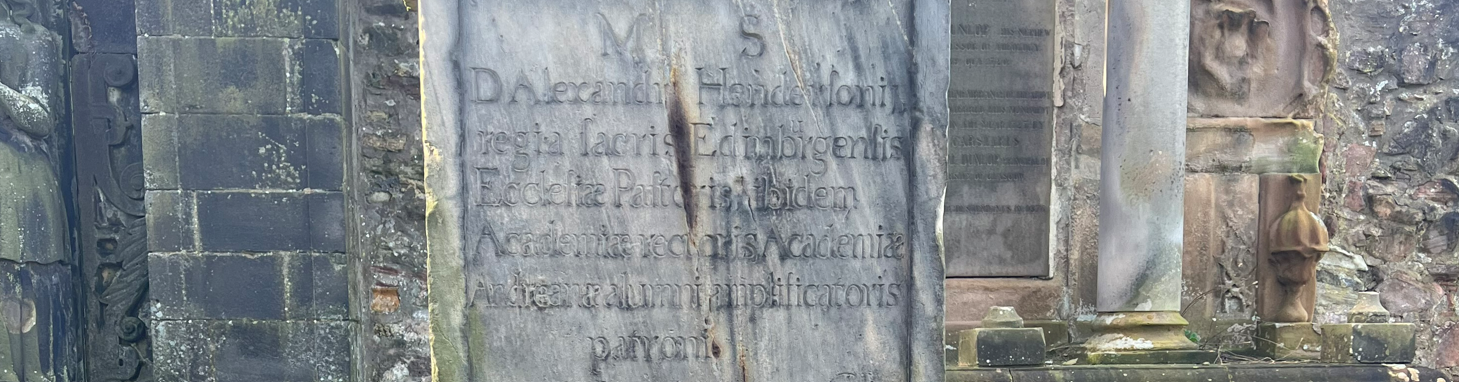
| Alexander Henderson Matters in Scotland were moving swiftly to a crisis and it was largely through his influence that the National Covenant was drawn up and signed in 1638. |
| Robert Blair ln process of time Mr. Blair had help from other ministers, who came over from Scotland [to Ireland] when persecution became hot there. Their joint labours were countenanced by the Most High, and there was a general revival of religion over a wide area. |
| Samuel Rutherford The fame of his name will also live on among those who appreciate our Presbyterian heritage, and prize our religious and civil liberties. Samuel Rutherford, renowned as “the saint of the Covenant”, was one of the greatest men that Scotland ever saw, whether considered as a preacher, theologian, devotional writer or political theorist. |
| George Gillespie Ordinance of Church Government Vindicated. It was dedicated ‘to the reverend and Learned Assembly of Divines convened at Westminster,’ and was published in London in 1646.” In this book he deals, first, with the government of the Jewish Church, showing that it was distinct from the State. |
| James Durham His call and coming forth to the holy ministry was remarkable. The Scots army being about to engage with the English, he judged it proper to call his company and soldiers to prayer before the engagement. And as he was beginning to pray, it happened that Mr. Dickson, professor of divinity then at Glasgow, came riding by the army, who seeing the soldiers addressing themselves in prayer, and hearing the voice of one praying, drew near, and lighted from his horse and joined with them. |
| Hugh Binning Among those who adorned the Church of Christ in this world there were many whose work was finished at an age when the greater number of its most useful members were only beginning their life’s work. Of these there does not seem to be a more outstanding instance than Mr. Hugh Binning |
The National Covenant of Scotland 1638
| The National Covenants But a better day may yet dawn, when, under the outpouring of the Holy Spirit of God, these kingdoms will repent of their backslidings, and renew their solemn engagements with God, thus realising the fulfilment of the famous prediction of James Guthrie, the martyr, uttered on the scaffold, in immediate prospect of beholding the face of God and the Lamb, “The Covenants, the Covenants, will yet be Scotland’s reviving.” |
The Killing Time
| Alexander Peden IT has been truly said that “of all the Covenanters who figure in the history of the last persecution, which, with increasing bitterness, extended over the long period of twenty-eight years, from 1660 to 1688, no one had a more remarkable career, or is better or more lovingly remembered in death, than Alexander Peden.” |
| Richard Cameron At Ayrsmoss, or Aird’s Moss, this confidence was put to the test, and Providence seemed to be on the side of the big battalions. The Covenanters were hopelessly defeated; Richard Cameron was among “the ripe” who fell, and others of the leaders were reserved for a more cruel death. |
| Emilia Geddie – A Child of the Covenant The month before Emilia Geddie died she no doubt heard of the triumphant end of Isabel Alison, a native of Perth, who gave her life, saying, “I lay down my life for owning and adhering to Christ’s kingly office, His being a free king in His own house” – Along with her died Marion Harvie, scarcely twenty years of age, singing the 23rd Psalm, and saying, “I’d rather die ten deaths than want an hour of His presence.” But, on the other hand, Emilia was taken home without violence. |
| Battle of Drumclog IT was on a fair Sabbath morning, 1st June, A.D. 1679, that an assembly of Covenanters sat down on the heathy mountains of Drumclog. We had assembled not to fight, but to worship the God of our fathers. |

The Solway Martyrs
| Margaret Lauchlison and Margaret Wilson THE story of the drowning of Margaret MacLauchlan or Lauchlison, an aged woman, and Margaret Wilson, a girl of 18, in the Solway Firth in 1685, for testifying to the crown rights of the Lord Jesus Christ is one of the most pathetic in the annals of Scottish Church history. |
The Last Martyr in Scotland
| James Renwick The Popish priests declared him an obstinate heretic, and his short answer to them led to a byword among the prison officials, “’Begone,’ as Mr. Renwick said to the priests.” |
The Glorious Revolution until the Disruption
| Thomas Boston of Ettrick It was in 1712 that Boston commenced the writing of the Fourfold State, and it is scarcely needful to say that it is as the author of this book that he is most widely known. Probably no theological book ever exercised such a mighty influence on the religious life of Scotland; and the sphere of its influence was not confined to Scotland alone |
| John Willison of Dundee In about a month after its publication what is known as the Cambuslang Revival began; he hastened to the place and was privileged to be an eye-witness of this remarkable outpouring of the Spirit of God. On his way home he preached at Kilsyth from Psalm xl. 2, 3, and the impression made by his sermon proved to be the beginning of a similar movement, at Kilsyth. |
| The Secession of 1733 ON 5th December, 1733, the Succession Fathers – Ebenezer Erskine, William Wilson, James Fisher and Alexander Moncrieff met at Gairney Bridge, which lies on the Great North Road between Edinburgh find Perth, three miles from Kinross, and after some time devoted to prayer, they formed themselves into a Presbytery. There were also present Ralph Erskine and Thomas Mair who, while in sympathy with the Four Brethren, had not yet cast in their lot wholly with them. |
| John Brown of Haddington His struggle with the hindering circumstances of poverty, his indomitable spirit in acquiring knowledge, his piety as a humble follower of the Lord Jesus, and his faithfulness and zeal as one of His ministers, all tend to give John Brown a place among the noted men of a land which has had its own goodly band. |
Revival of Religion at Cambuslang
| The Cambuslang Revival (1742) “Setting aside all those that appeared under awakenings here in 1742, who have since remarkably backslidden, there is a considerable number of the then awakened that appear to bring forth good fruits. I do not talk of them at random, nor speak of their number in a loose, general, and confused way, but have now before me, at the writing of this, 27th April, 1751, a list of about four hundred persons awakened here, at Cambuslang, in 1742, who from that time to the time of their death, or to this, that is, for these nine years past, have been all enabled to behave, in a good measure, as becometh the gospel, by anything I could ever see, and by the best information I could get concerning them.” |
The Gospel comes with Power to the Highlands
| Religion in the Highlands after 1688 And the sermon preached on that bright autumn Sabbath of 1716 was the beginning of a great moral revolution and blessed revival in that beautiful strath. |
| Hector Macphail of Resolis He entered on the solemn work of the ministry an un-converted man; but a great change came over him, and his labours were acknowledged in a signal manner by his Master, whom he so devotedly served. |
| James Fraser of Alness Indeed, one may say, without exceeding the bounds of truth, that the illustrious title marked out for Gospel ministers by Paul, when he says that they are the glory of Christ, eminently belonged to him |
| Lachlan Mackenzie of Lochcarron Much of his time was spent on his knees, and many a sleepless night has he passed, sometimes wrestling, as for his life, against the assaults of the tempter, and at other times rejoicing in the hope of the glory of God. The nearness to the mercy seat, to which he was sometimes admitted, was quite extraordinary. Proofs of this might be given, because of which we cannot wonder that he had the fame and influence of a prophet among the people of the North. |
| John Kennedy of Killearnan OF all the northern ministers there is scarcely any name that stands higher in the estimation of the Church of God than that of the Rev. John Kennedy, minister of Killearnan |
| John Macdonald of Ferintosh, Apostle of the North The excitement at last was very great, the groans and outcries of the stricken ones sometimes drowning the voice of the preacher. During the closing service on Monday the same scene was repeated” (The Apostle of the North, p. 80). This was the beginning of a revival which continued for some time. |
The Free Church 1843 to 1893
| John “Rabbi” Duncan, Professor of Hebrew One of these lectures, entitled “The Work of the Holy Spirit in connection with the Conversion of the Jews is a truly noble production, full of genius, massive doctrine, and solemn, wise affectionate appeal to the Jewish people. In the year 1838 there was the dawn of a new era in the history of Mr. Duncan, which led to the dissolution of his tie with the Milton Church. Much interest had arisen in the Church of Scotland on the subject of the conversion of the Jews, and Mr. Duncan was appointed a member of the Glasgow Jewish Committee. The issue was that he formally offered his services as an agent of the Church, either at home or abroad, for the promotion of Christianity among the Jews. |
| John Kennedy of Dingwall He also deplored a presentation of the gospel which ignored or belittled “the sovereignty and power of God in the dispensation of His grace”, and for this reason, among others, he criticised the Moody and Sankey revival movement of the day, in his pamphlet, Hyper-Evangelism, (1874). (See review of Revivals in the Highlands and Islands by Alexander MacRae). |
The Free Presbyterian Church of Scotland 1893 Onwards
| Rev. Donald Macfarlane of Raasay and Dingwall He was not prepared to change his Protest into a Dissent and remain in a Church that was bound by the Declaratory Act, and having left his Protest in the hands of the Assembly he thereby separated from the Free Church. Thus began the movement which later took the name of the Free Presbyterian Church of Scotland. |
| Rev. Neil Cameron of Glasgow As a witness for the truth no one who ever listened to him could help feeling here was a man who eared nothing for the opinions of men however great they were in comparison with the truth of God. His whole life since the day he made a public profession was a clear and ringing testimony for God’s Word and Truth. Perhaps no minister of our day was so devotedly loved by many and so heartily hated by others. |
Read more about the great revival of religion at the Millennium. And the future National Conversion of the Jews by Jonathan Edwards here.
Read here more about the nature of the Church of Rome. Against whose machinations the Scottish Reformers and Scottish Covenanters struggled.